

EU Bioeconomy Breakthroughs: Turning Waste and Pollution into Profitable Green Innovation
Europe is accelerating its transition to a future where waste, pollution and overlooked biological resources are not liabilities — but business opportunities with real economic and environmental value. A trio of EU‑backed LIFE projects are demonstrating how sustainable bioeconomy solutions can create new markets, support rural jobs and help the EU meet its climate goals.
Why Bioeconomy Matters Now
The bioeconomy refers to systems that use biological resources — such as biomass, industrial by‑products and microbial processes — to generate sustainable materials, energy and services. Across the EU, this sector already contributes up to €2.7 trillion to the economy and supports over 17 million jobs. Yet, policymakers believe much more growth and innovation is possible with the right incentives and technologies.
To help unlock this potential, the European Union recently released an updated EU Bioeconomy Strategy, designed to help innovators bring bio‑based solutions to market and build stronger, greener industries across the region.
Transforming Grass Clippings into Green Gas
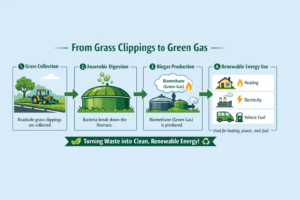
One remarkable example comes from the Netherlands with the GR4SS project, which tackles a surprisingly abundant — yet neglected — resource: grass cuttings from roadsides. Instead of letting this biomass go to waste, the project collects it and feeds it into anaerobic digesters — machines that break down organic material to produce biomethane, fibers for soil improvement and other useful outputs.
Initial results are promising scaling up just ten of these digesters could generate 25 billion litres of green gas and cut carbon dioxide emissions by over 125,000 tonnes — all while offering new revenue streams for farmers and rural communities.
General explanation:
Grass Clippings
- Grass clippings are the leftover pieces of grass after mowing lawns, parks, or roadsides.
- Normally, they are discarded or left to decompose, but in large quantities they are considered biomass — basically a renewable organic material.
- In bioeconomy projects like GR4SS, these clippings are collected and reused instead of being wasted.
Green Gas
- Green gas is renewable energy in the form of methane (the same chemical as natural gas) produced from organic waste, such as grass, food scraps, or manure.
- Process used: Anaerobic digestion
- Microbes break down the organic material in an oxygen-free environment.
- This produces biomethane, which can be used for heating, electricity, or vehicle fuel.
- Why it’s “green”:
- It reduces greenhouse gas emissions compared to fossil fuels.
- It turns waste into a useful resource, closing the circular economy loop.
Example: Instead of letting roadside grass rot or be burned (which releases CO₂), the GR4SS project collects it, puts it into digesters, and produces methane gas — which can then power homes, vehicles, or industry sustainably.
Turning Industrial By‑products into High‑Value Chemicals
In Spain, the ZEBRA‑LIFE project is finding value in a substance most companies consider waste. “Black liquor” — a by‑product from pulp and paper manufacturing — is typically burned for energy recovery. ZEBRA‑LIFE, however, extracts bio‑aromatic compounds from this material, creating renewable antioxidants and UV‑filter additives.
These bio‑based products can rival or outperform conventional synthetic chemicals and have applications across cosmetics, polymers, fuels and lubricants — proving once again that waste streams can feed profitable circular value chains.
Restoring Polluted Land with Nature’s Helpers
Not all environmental challenges stem from useful biomass. Large areas of land across Europe are contaminated with total petroleum hydrocarbons (TPHs) — pollutants from fossil fuels that make soil unsafe or unusable. The MySOIL project, operating in France, Italy and Spain, uses fungal‑based bioremediation to clean these soils.
Rather than expensive and energy‑intensive industrial cleanup methods, MySOIL’s biological solution can remove up to 90 % of TPHs, making land viable again for agricultural use, conservation or community development.
Innovation with Broader Impact
These three initiatives — GR4SS, ZEBRA‑LIFE and MySOIL — highlight how bio‑based innovation can turn problems into practical, profitable solutions. Beyond their individual impact, the real‑world data they generate about costs, environmental performance and market potential strengthens the case for scaling similar approaches across Europe.
What’s more, these projects align seamlessly with wider EU strategies, from the European Green Deal to soil protection and renewable energy directives, ensuring they contribute to broader climate and sustainability targets.
Source of Information:
Bioeconomy breakthroughs: LIFE projects transform waste and pollution into new business opportunities – European Climate, Infrastructure and Environment Executive Agency news release, 18 December 2025
Next Recommended Read :